2020 - Control Was Always an Illusion. Covid Just Made It Obvious.
Year five. A pandemic locked the world down and somehow it clarified everything — we'd been living without the illusion of control the whole time. Here's what that felt like from the road.
This year has been different ... way different. We're in South Korea as we pass 1,825 days of living life out of a carry-on bag.
This is our fifth year of full-time travel. From the beginning, this journey has been filled with unexpected bumps in the road. Sometimes a flight is delayed. Maybe a taxi fails to pick us up. With some frequency, we're served a dish we didn't realize we'd ordered.
We had planned to be in Tirana, Albania today. That plan evaporated, along with any illusion of control, early in 2020.
Let's back up for a second
My wife and I have been traveling for five years. We started our journey on our twenty-fifth wedding anniversary--June 23, 2015. We've visited more countries than I can count. We've met more people than I can remember. We've eaten more kinds of food than I even knew existed. And we've had more fun than we deserve. It has truly been amazing. We've learned a lot and our digital nomad life isn't always the same as that of some younger digital nomads so be sure to check out 11 truths we've discovered for older digital nomads.
In our minds, our "year" runs from June to May. It's bookended by a return trip to our old home, Raleigh, North Carolina. We drop back into the area to see family and friends, get our teeth cleaned, and get our annual physicals.
A quick review of the past twelve months
Back in May of 2019, after an enjoyable ten days of seeing family and friends, we headed off for a year in Latin America. We've figured out that this lifestyle is easier if we focus on a particular region rather than zigzagging all over the planet. Staying in one or two time zones, minimizing long flights, and using fewer languages helps us stay sane-ish.
Peru
We headed down to Peru and ate and ate at some of the world's best restaurants in Lima and Cusco. We also managed to make our way to the tops of two peaks at Machu Picchu, and enjoyed quite a few weeks just soaking up the Andes scenery.
Bolivia
After nearly two months in Peru, we flew over to Bolivia to see the salt flats and La Paz. Late July is midwinter in Bolivia; we were freezing, and when the snow started falling, that seemed like a good reason to wrap it up and fly away.
Ecuador
We zipped over to Ecuador to see Quito. Then we spent some time on a yacht in the Galápagos Islands, followed by a month in a very tiny Pacific coast town called Puerto Lopez, where we did some whale watching. Ecuador exceeded our expectations on the nature front.
Panama
The continuing chilly weather drove us north to Panama after 7 weeks in Ecuador. The highlight of Panama City was the canal. We were oddly fascinated, and spent a couple of days exploring the locks at both ends and watching ships pass through. Then we flew over to Boquete to enjoy the mountains, followed by a week on a sailboat we chartered in the San Blas Islands, which were both beautiful and warm.
Chile
Once we had thoroughly thawed out in Panama we flew back south to Santiago, Chile, where the air was cooler but the politics were hotter. We had a chance to see the ongoing political protests from a safe distance.
Then we flew down to a small town--Punta Arenas--which was much calmer, until a small group of protesters torched the building immediately next door to our hotel. A massive fire ensued, accompanied by soldiers with water cannons and tear gas. It was quite a show. We quickly headed down to Patagonia where the scenery was calmer and beyond amazing.
Argentina
After three dramatic weeks in Chile, we crossed the border to Argentina where we spent nearly two months. In El Calafate we visited glaciers, in Bariloche we drank beer and hiked in the mountains, and in Buenos Aires we enjoyed the sights, a holiday visit from family, and the beef.
Brazil
Iguazu Falls drew us briefly to Brazil where we stayed inside the national park and woke up each morning to a waterfall that was unlike anything we'd ever seen. Amazing.
Uruguay
Sometimes we need to get some work done. Too many great tourist attractions make it hard to be productive. A month in Montevideo, the capital of Uruguay, proved to be the perfect spot to catch up on work. The city is modern, functional, and convenient. We found great food, nice people, and beautiful waterfront walkways for getting some exercise. A couple of weekend drives gave us a greater appreciation for everything Uruguay has to offer.
Nicaragua, El Salvador, Guatemala
Then we went full tourist and jumped into Central America with both feet. It's hard to get work done when we're moving quickly, so we abandoned work mode and embraced holiday thinking. Two weeks on Little Corn Island in Nicaragua, followed by a Pacific beach in El Salvador, and then a quick visit to the Tikal ruins in Guatemala made for a great vacation. There were definitely some pina coladas involved.
Mexico: The wheels started to come off
We arrived in Puebla, Mexico for a week of eating. We'd long wanted to visit the city, and we loved all of the Mexican food we consumed. But at that point (early March), the virus was clearly becoming a thing. Temperature checks in most Central American airports alerted us to what was coming as we arrived in Mexico. Tension was in the air.
Then, just as we checked in at a Hilton Resort in Playa del Carmen, the US announced a travel ban.
The resort was going strong when we arrived but quickly became eerily quiet and a little weird. We'd booked this place because we'd found an amazing deal months earlier. As guests headed for the exits, the pool crew continued to play loud dance music and conduct bikini contests--it was surreal. Social distancing was now a thing, and it was easy at the gigantic, empty resort, but it was uncomfortably bizarre.
The plan, after that week at the resort, was to spend March in Mexico City in an apartment. We were scheduled to leave the resort early Sunday morning. We figured we'd just hole up in the apartment away from other people, but we weren't so sure about Mexico City.
Our research told us to ride the virus out in a place with hospital beds. The best information said go where there's solid infrastructure. Mexico City was quickly out.
Tokyo had very few Covid-19 deaths, a huge number of hospital and Intensive Care beds, and was still open to us, as Americans entering from Mexico. We'd considered Hong Kong, Taiwan, and Singapore. They were either closed or closing.
We made the decision at 9:30 PM on Saturday night, and booked a flight to Tokyo. Six hours later we were in the air, bound for Japan on a mostly empty plane. We spent a very long night worrying every time someone coughed.
We headed to infrastructure
After five weeks in Tokyo, still with only a couple of hundred deaths, Japan declared an official state of emergency. Business slowed down fast. The streets got emptier as shops and restaurants closed. Everyone was inside their homes. We were inside our Airbnb. It was clear that Japan was going to shut down tight for at least a while.
Should we stay? Should we go? There were no good answers, and the variables had grown exponentially. We spent a week debating our options.
A quick flight out
And that brings us to Seoul. We jumped on a short flight over to Seoul. The drive to Narita Airport, just outside of Tokyo was fast, with zero traffic. The huge airport was empty--silent. It was disconcerting.
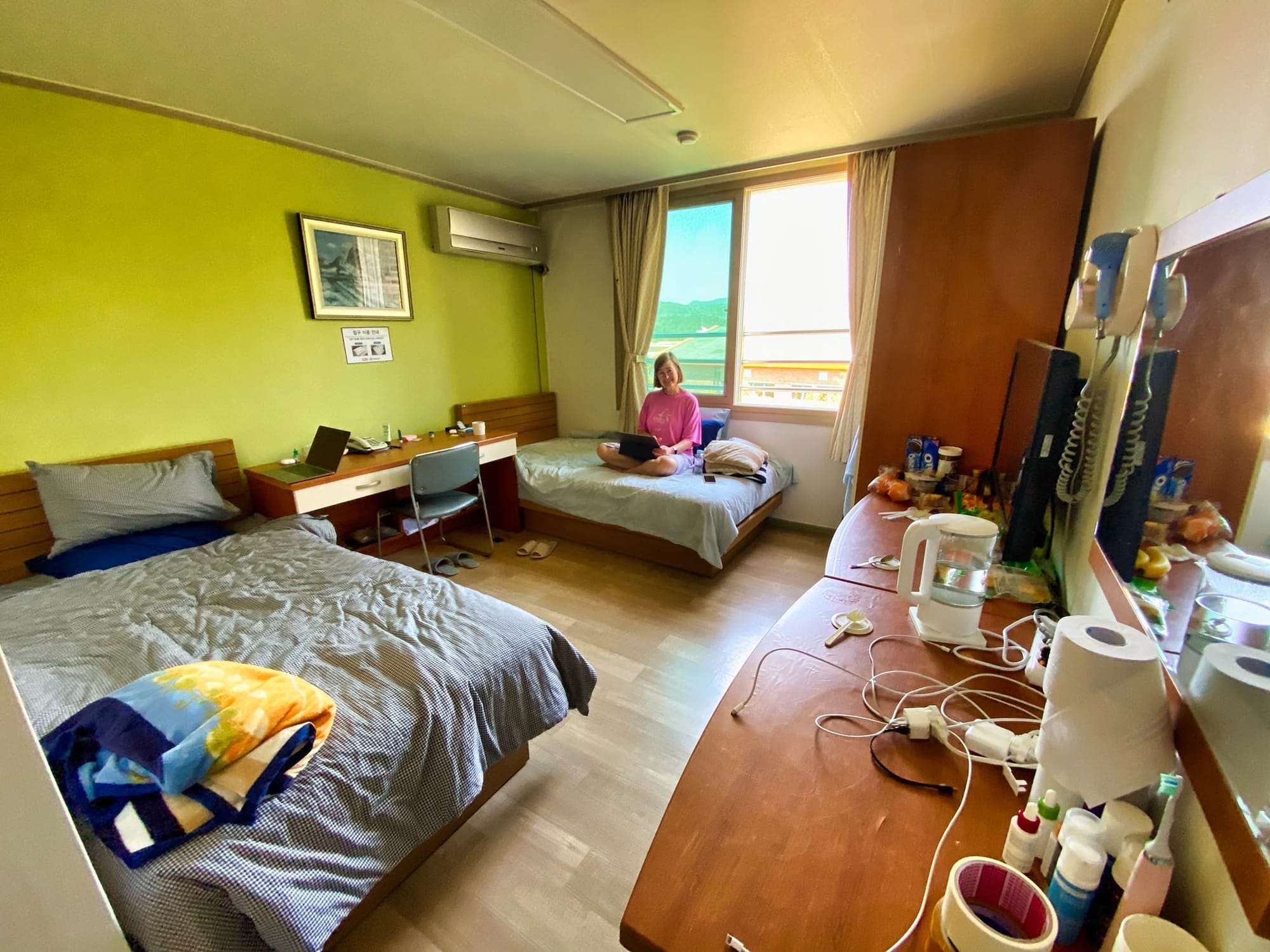
Our flight was mostly empty. We landed in Seoul just two hours after takeoff. Police and soldiers processed us and escorted us to a private bus, and an hour later we were sealed up in a dorm room on a government campus, two hours south of the airport. The fully hazmat-suited quarantine center workers who showed us to our room were the last humans we saw for the two weeks of our mandatory quarantine. Even the three meals that were delivered each day were left by the door for us to retrieve, with zero contact.
So many folks we know have struggled with working from home. We've been working from "home" for years. We're fully functional with a laptop, a mobile phone, and earbuds--no adjustment required.
We're oddly well suited for the confines of quarantine. When South Korea confined us to that 11 x 11-foot room, we were fine. In fact, that room was bigger than some we've had along the way. The constant disinfection of the hallway beyond our door just made us feel more secure (we've been in plenty of hotels that could've used a bit more disinfection!).
Then, after two weeks, we were released in Seoul.
Freedom. But still, a slightly weird version of freedom. There is very little community transmission in Korea, but our awareness of the virus hasn't simply disappeared, even in the relative safety of Seoul. We're still on alert, at some level; the virus is always there, in the back of your mind. Touching a doorknob still doesn't feel the way it used to feel. I'm guessing you know exactly what I mean.
Going forward
We've been pretty flexible for a long time, living as we do. But this virus is requiring flexibility on an entirely new level.
There are safety issues, of course. But there are also moral issues, border issues, quarantines, airline issues, complexities involving transit airports in countries that are prohibiting passage, countless forms, temperature checks, and more. Living this lifestyle just got much more difficult.
As the environment changes, everything is trickier. I'm reminded of the lessons I was taught when getting my pilot's license. The instructor explained the danger of flying into a blind canyon. If you're not careful, the plane ends up in pieces on the canyon floor when you discover there's not sufficient distance to climb over the canyon wall.
It's easy right now to end up in a country where one can't legally stay, but from which one can't easily travel to a place they'd like to go. We could inadvertently end up in a place we don't want to be, and which leaves us with options we'd rather not choose.
We're free from our most recent quarantine, but we're not really free. I suppose this is how it feels to be from most countries in the world where passports aren't so powerful and money is often tight. It's good to be reminded of all we take for granted. But I have to admit--it's an uncomfortable lesson.
Grieving our loss
Looking back on the year, it's sad how much of it seems like a faint and distant memory, now overshadowed by the virus. So many people, places, meals, and experiences are buried by the crisis taking over our memories. It'll be interesting to see how it all looks a few years from now when we can see it with some perspective.
Right now it just feels like loss. Some of it is trivial--like how hard it is to see when the mask makes my glasses fog up. Some of it is overwhelming, when we've experienced the loss of someone to whom we have a strong connection. It's difficult to see a silver lining right now.
Going home
So many folks we know are hanging out at home. We have no home. We're used to that idea, and it has always been a little weird. But it's definitely weirder right now. We've watched as hotels have closed, airlines have shut down, borders have been sealed--it's an environment that makes one very conscious of the desire to have a secure nest, somewhere in the world.
Some have suggested that we go back to the United States. We might. That might prove to be our only option at some point. But at this stage, it's a bit challenging to know exactly where home might be. We're not quite sure where we belong.
People are on their best behavior
I'm sure the loss of control we're all feeling triggers panic in many. Panic doesn't always turn out well. People do crazy things when they're frightened. They get angry. They behave badly.
But that's not what we've observed.
We're feeling like people around the world are kinder, gentler, more welcoming and open.
Our experience has been one of people reaching across boundaries to help. The quarantine team in South Korea scooped Lisa up when she stumbled. The soldiers at the airport were all kindness. They kept us informed as we were processed, and even though we couldn't see their smiles, we could see welcoming eyes behind their protective shields. The people helping us in stores, restaurants, taxis, and airports have all been more human than usual. It's nice to see people, even behind masks, coming together, rather than letting this crisis push us apart.
So what's next? Where do we go? What do we do now?
We don't know. Control was always an illusion. Covid-19 just helped us see that a little more clearly.