2021 - We Survived on Covid Tests, Business Class, and Luck
Year six. Covid was supposed to ground us. Instead we learned to navigate it — with tests, masks, business class bubbles, and a fair amount of luck. Still moving.
The last time I updated you on our nomadic existence, we were in Seoul, South Korea, hiding out from Covid. We're still hiding out, but we've developed some (so far adequate) virus avoidance skills. We've made it through another year with a bit of luck, a lot of Covid tests, and masks firmly settled on our faces.
Making our lifestyle work under the current circumstances has been challenging, and we've had to adapt to protect ourselves and others. Thankfully, we've been lucky so far and are alive and well. Sadly, that's not true for millions of others. We're cautiously optimistic that this will end at some point, but much of the world is still living under a pretty dark cloud.
We try to make the best of awful situations. That has been true throughout our journey. This adventure has been filled with ups and downs. This year, during the chaos of the pandemic, we lost track of a guy we had been talking with about once a month via Messenger. He's a tour guide we spent three days getting to know in Axum, Ethiopia—the Tigray Region. Reports of mass killings in the area, simultaneous with his disappearance from social media and complete radio silence on Messenger have left us fearing the worst. We may never know what happened.
It's hard for us to wrap our brains around the loss of millions from the virus. It's much easier to imagine soldiers killing 800 people under the giant fig tree in the small village where our friend lives in Ethiopia.
Making light in the darkness
While much of what's happened over the past year is horrible, it never hurts to look for a bit of humor in every situation, even if it is very dark humor. That led me to wonder about the answer to this question: if you’re flying business class, who cares how long the flight lasts?
It’s an obnoxious question, which I find darkly amusing, but it became our reality for this pandemic year. The pandemic changed lots of things for us, like everyone else. Flying business class seemed safer. I'm sure you understand. It's not like we wanted to fly up front; it was the pandemic.
In prior years we’d adopted a philosophy of staying put in a geographic region for quite a while, in order to avoid long flights, jet lag, and language adjustments. Most recently that meant spending nearly a year in South America, bopping around between countries.
But the pandemic sent us back to the drawing board, in search of countries keeping the outbreak in check. Quite often that meant a long flight from continent to continent. That’s where the credit card points came in handy, because business class is the only way to fly when the flight stretches from one day to the next, and our fellow passengers might be exhaling a virus.
This past year in a nutshell
We spent an inordinate amount of time consulting Covid data this past year. We tried desperately to stay out of the way of the virus spread. The data showed us our path.
But, even with data, we were rarely comfortable. Airports, even nearly-empty Covid-free airports, were creepy. It was apparent that we wouldn’t get infected waiting at the gate when we were the only people we could see (other than the gate agent, who was wearing full PPE). But it was still creepy: the big empty spaces, the silence, the metal gates drawn down in front of the duty-free stores, and the occasional cleaner spewing chemicals from a sprayer. Empty airports were a potent reminder of the threat—all very disconcerting.
Then, upon arrival in many places, we were quizzed by border police in broken English; every time, we wondered where they might send us if they didn’t let us through the gate. Travel for the past year has not been welcoming, festive, or light-hearted. It has been strange, uncomfortable, and off-putting.
The itinerary
In our minds, our "year" runs from June 23 to June 23. That’s because we started traveling full-time on June 23, 2015, our 25th wedding anniversary. We typically drop back into our old stomping grounds in Raleigh, North Carolina around that date each year, before heading back out.
We didn’t make it to Raleigh in 2020, nor have we been in 2021. We’re waiting a bit before resuming our routine. Maybe I'll start writing these updates from January to January, since our old approach to tracking time has been broken by Covid—like so many things. We shall see.
Mexico: We started the pandemic back in early 2020 in Playa del Carmen, Mexico. It took us about twenty minutes of reviewing the health care system in that area to realize we didn’t want to be there if the pandemic panned out as predicted. We flew from Playa to Tokyo on the spur of the moment in March of 2020. The business class upgrade didn’t entirely distract us from the pandemic stress of air travel in those early days.
Japan and South Korea: We spent about five weeks in Tokyo before popping over to Seoul, South Korea. South Korea knew how to do a pandemic. They had it down. I could spend an hour telling you how well they managed the virus—it was amazing—and we felt perfectly safe for four months. In retrospect, the South Koreans handled the pandemic better than any other country we visited. They understood, early on, the airborne nature of the virus and implemented filtration, masks, and other interventions. Their tracking and tracing were stunningly efficient, persistent, and transparent. They took a very aggressive stance and it paid off.
We were in Seoul when I wrote my 2020 update. The South Korean government was encouraging domestic travel, so we were able to enjoy some time at the beach in Busan and out on Jeju Island. South Korea has quite a bit to offer and we thoroughly enjoyed our time in the country.
Scotland: As the weather warmed up in Europe, and the virus numbers went down, we flew (business class again) over to Scotland. We knew we could stay out in nature and avoid people up in Orkney and the Shetland Islands. Those islands are spectacular. Walking through the sheep-poop-dotted green grass, along the tall cliffs, looking down at the ocean crashing into the rocks, is pretty amazing.
England: We then headed down to London for three weeks, and it was apparent that the virus was about to make a grand reappearance. We stayed outside and away from people. From our outside tables, looking in through the windows, we could see nothing but packed restaurants filled with diners paying with half-off coupons provided by the government. We hit the road for Germany, a stepping-stone that would enable us to get into Bonaire, a Dutch island in the Caribbean.
Germany: We landed in Frankfurt, rented a car after the border police let us in, and promptly pulled over to a bus stop to open Google maps. Within five minutes we picked a destination and hit the road. After a quick visit to Koblenz, we headed to Dusseldorf. We spent our time there eating outside in the cold and rain of October, while waiting for the clock to tick off two weeks so that we could fly to Bonaire. Again looking through the windows into the full restaurants, we were reminded of London, which had gone to red-alert status right after we departed. It wasn't much of a surprise when the Covid numbers exploded shortly after our departure from Germany.
Bonaire: We landed in Bonaire in mid-October to warm weather and sunny skies. Bonaire was pretty much the perfect place to weather the storm. The restaurants and all activities were either outside or underwater. While we were on the island there were almost no cases of Covid, although the community had recently lost a beloved doctor to the disease. As a tourist destination with nearly zero other jobs, the island struggled mightily with striking a balance between health and the economy. Our sense was that the virus was slowly going to catch up with Bonaire. We exited to Dubai.
Dubai: Our business class seats to Dubai were on KLM, which, while very nice, isn't quite as glamorous as Emirates. Nonetheless, we arrived in style in the land of luxury, abundance, and excess. We've now visited Dubai a number of times, and have friends there, so our visit was terrific. We enjoyed a Christmas feast outside next to the fountain at the Burj Khalifa, and then watched the building light up for New Year's Eve. The crowds in Dubai Mall told the story of a coming Covid outbreak. It didn't require an epidemiologist to know that all those British revelers were bringing their particular form of the virus to the desert.
Bangkok: We were missing something as we jetted from Mexico to Asia to Europe to the Caribbean and back to the Middle East—our eldest kid. He lives in Bangkok and we hadn't seen him in a very long time because Covid struck at exactly the wrong time in our travels. We'd been planning on a visit when the virus started spreading and everything went into a holding pattern. Thailand was the first country, after China, to experience Covid, so they were tightly locked down. We'd started inquiring about a visa while we were in South Korea, and the responses were all affirmative, with smiles and nodding, yet nothing happened during our visits to the Thai Embassy. The Land of Smiles was closed, even if they didn't always say so directly.
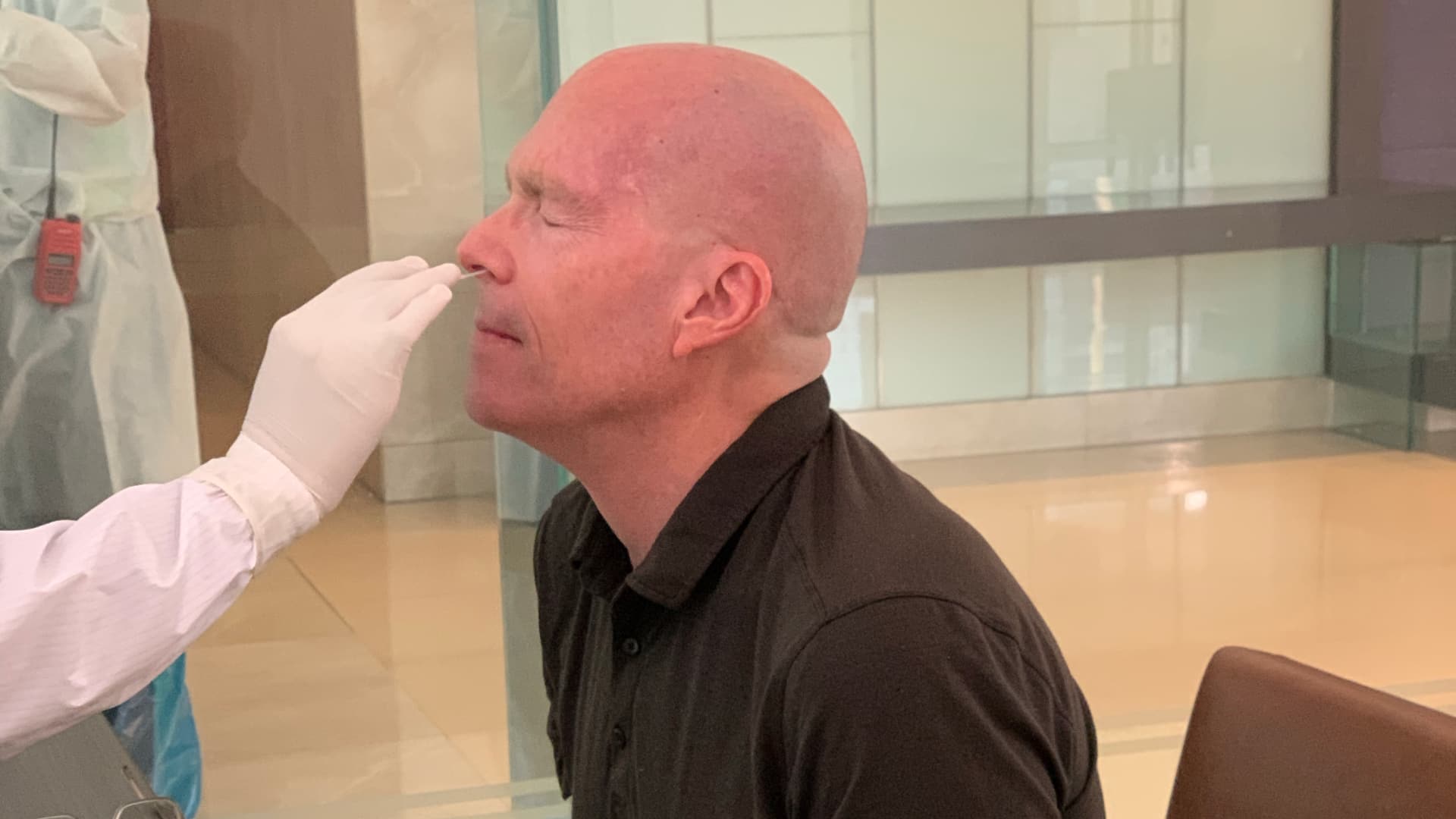
But while we were on Bonaire, we sensed that the door was beginning to crack open, and it became clear that we could make it into Thailand. After filling out lots of forms and sending several express-mail packages to the Thai Embassy in Washington, we had our visa. Then, the day before we were booked on KLM's business class flight out of Bonaire, we went out behind the medical clinic to a dirty plastic chair next to the sweltering tropical medical supply dumpster. A nice Dutch nurse came outside with a long q-tip on a wooden stick and jammed it up my nose. It was kind of like business class, but without the beautiful flight attendant, luxurious leather chair, and hot meal.
Whatever was in our noses met with the approval of the Thai authorities. We were admitted to Thailand and promptly sealed into a quarantine hotel by men in blue protective gear. On the way in, of course, our noses were probed again, and then again five days later, and then again seven days later. My nose never saw it coming.
Then we were given our freedom in Thailand, where we spent nearly three months with our kid, visited mostly empty tourist attractions and enjoyed many meals as the only customers in the restaurants. Thailand, like the airports around the world, was empty.
Iceland: Something happened to Lisa's foot in Thailand. The aerobics she did in quarantine may have been the cause, but it could have been anything. An MRI revealed that her tendon is torn. She was given a fancy boot to wear and told to rest. The medical treatment in Thailand was top notch, but our visa ended, so we flew off to Iceland, which has consistently handled the virus well. Upon arrival we started the journey to find a foot-repair doctor. After waiting nearly a month to see a doctor and get another MRI, Lisa was able to remove the boot. She still has some discomfort, so surgery might be in her future. We would like for her tendon to do the right thing by healing itself, but we're not particularly optimistic.
More nomad lawyers
Over the years of our traveling, we've encountered a few nomad lawyers. They've messaged, we've talked, and sometimes we've met up. But those interactions have been pretty rare. Most of the nomads we meet are software developers, writers, or people who do some kind of online marketing or trading.
But Covid brought out the lawyers. With remote hearings, the kids out of school, and clients adapting to meetings on Zoom, the lawyers were set free and some of them escaped their cages.
I've had quite a few calls with lawyers who flew the coop. Lawyers took the opportunity to work from quiet international destinations in the countryside or on the coast, where they had good internet, outdoor dining, and fewer people crowding the environment and spreading the disease.
Some of these lawyers returned home as schools resumed, but some are making the change more permanent. We've been pleased to help some folks see that there are so many options.
Lessons learned
All of us have learned more about viruses and pandemics and loss than we ever wanted to know—that's for sure.
But most of us have learned some positive lessons along the way, as well. For us, there have been too many to list.
One that stands out is the benefit of spontaneity.
We're planners. We often planned our travel a year in advance, to take advantage of grabbing seats or rooms early so that we could book with points. Planning is great, but it has its drawbacks. Loosening up a little is always a good thing.
At this point, we're pretty spontaneous. The virus has taught us that booking in advance can be filled with disappointments, refunds caught in bureaucracy, and being unable to stay longer than we planned or leave earlier than we had scheduled. Spontaneity has its benefits.
We've taken to booking flights in the taxi on the way to the airport. We're waiting to book rooms after we get past the border police. Planning has mostly gone out the window. We're just a small step away from being those people walking through the terminal, seeing the flight to Algiers, and jumping on while we cancel the flight we'd originally booked. We haven't done that yet, but it could happen.
Maybe we'll do more planning post-pandemic, but we won't soon forget the lessons we've learned, about spontaneity and lots of other things. The pandemic has been quite an experience, in too many ways to count.
Epilogue: Some good news
My notes to you are written several weeks in advance of publication in order to allow time for my editors to clean things up, fix my mistakes, and make me seem smarter and more capable. It's a nearly impossible job and I thank them for their work.
During the lag time for this post, several good things have happened, and I figure we can all use all the good news we can get, so I wanted to share.
The really big news for us came in the form of a text message from Ethiopia at 6:05 one morning.
Hello dear Lee.
How are you? Glad to meet you again.
I'm back after 7 months war and Genocide in Aksum, Tigray."
A sense of relief flooded through me. It was great to know he was alive. We haven't talked much since his message but I'm sure we'll continue to communicate and I'll hear stories.
In other news, the Icelandic government came through and vaccinated us, which was nice of them and another relief for us. It's good to have that behind us and it opens more doors. With the success of the Icelandic vaccination campaign, the masks have come off here so, again, a relief.
My mother used to say "the sun will come up tomorrow," and she was right. She's especially right in Iceland, where sunrise today is at 2:56 AM. Yep, the sun will come up tomorrow. Of course, it mostly won't go down, since sunset tonight is at 12:04 AM. Brighter days are here, indeed.